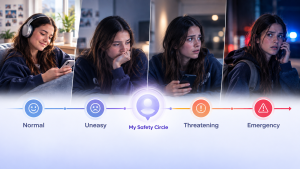
Personal Safety Is Changing for the Better
For years, many personal safety tools were built around a simple assumption: more access means more protection.
That often meant continuous location tracking, automatic sharing and monitoring that remained active even when nothing was wrong. The intention may have been safety, but the experience could feel more like surveillance.
A better standard is emerging: safety with consent.
People still want reassurance. Parents want to know their teenagers are safe. Families want to support older relatives. Friends want to look out for one another when travelling, exercising alone or meeting someone new.
But protection should not require people to surrender control of deeply personal information.
From automatic access to deliberate sharing
Location data can reveal where someone lives, works, exercises, socialises and spends time. It should not be treated as ordinary background data.
Consent-based safety starts with a different set of principles:
- Ask before accessing someone’s location.
- Let the individual decide what to share.
- Share information only when it is relevant.
- Keep the person in control whenever circumstances allow.
This changes the relationship between the person requesting reassurance and the person being checked on. Instead of assuming access, the system creates a respectful exchange.
How My Safety Circle approaches location requests
My Safety Circle’s Request Location feature is designed around choice.
When a contact requests a location check, the recipient can respond according to the situation. They may confirm that they are safe without sharing their location, choose to provide their location, or indicate that they need help.
The request does not automatically become permission.
That distinction matters. It allows families, friends and trusted contacts to stay connected without making constant monitoring the default. My Safety Circle’s wider approach is similarly designed to keep personal information under the user’s control until they intentionally choose to share it or a predefined safety event requires action.
Trust is part of the safety system
A personal safety tool only works when people are willing to use it.
Teenagers may disable an app that feels controlling. Employees may resist technology that allows unnecessary workplace monitoring. Independent adults may reject support that undermines their dignity.
Consent improves adoption because it gives people a reason to trust the system.
The future of personal safety is not about watching people more closely. It is about helping them share the right information, with the right people, at the right time.
Safety through respect. Sharing through choice.