At 11:15pm, you aren’t worried.
They said they would be home around 11. Teens run late. They probably missed the bus. They stopped for food. Their phone is buried in a bag. You tell yourself not to overreact.
At 11:30pm, you send a message. “Everything OK?”
No reply. You call, Straight to voicemail. Now the evening changes…
11:30pm: The Search Begins.
You try again. Then perhaps you message one of their friends. “Are you still with Jess?” No answer.
You check the family group chat. You look at the time their last message came through. You try to remember exactly where they said they were going.
Was it the party in Newtown? Or were they going somewhere afterwards? Who was driving? Did they say which train they were catching?
You realise that, despite exchanging twenty messages that afternoon, you don’t actually have much useful information.
Midnight: Concern becomes Uncertainty
There is a particular kind of anxiety that comes from not knowing whether you have a problem.
If your teenager called and said, “I’ve missed the last bus — can you pick me up?”, the problem would be simple.
But silence gives you nothing to work with.
Maybe the phone battery died. Maybe they lost track of time. Maybe they are somewhere noisy and cannot hear it. Maybe they are embarrassed because they know they are late. Or maybe something genuinely has gone wrong.
The problem is that, from home, all of those possibilities initially look exactly the same.
So parents do what people naturally do when they have too little information: they start searching.
12:30am: Now What?
You may now be calling more friends. Checking social media. Driving toward the last place you remember them mentioning. Trying to work out whether calling the police would be sensible or ridiculous.
And underneath all of it is the question every parent in this situation eventually asks: At what point am I supposed to do something?
That is the real 11:30pm problem. It isn’t simply that your teenager is late. It is that there was no agreed process for what happens when the plan stops going to plan.
Panic-driven searching versus a safety protocol
Most families have rules.
- “Be home by eleven.”
- “Text me if you’re staying later.”
- “Keep your phone charged.”
- “Call me if you need a lift.”
Those are sensible expectations.
But they are not quite the same thing as a safety protocol.
A safety protocol answers a different set of questions:
- What time are we expecting you?
- What should happen if you are running late?
- How long without contact is unusual enough for us to check?
- Who should be contacted first?
- What information will be available if you cannot answer?
- At what point does an ordinary delay become something we actively respond to?
The value isn’t in making every teenager behave perfectly. They won’t. The value is deciding these things before midnight, rather than while everyone is stressed.
The teen's side matters too!
There is an obvious objection.
No teenager wants to feel monitored every time they leave the house.
And they shouldn’t have to surrender their independence simply because their parents worry.
Growing up requires increasingly doing things without Mum or Dad standing nearby. This may be:
- Going to parties.
- Catching public transport.
- Meeting friends.
- Taking their first job.
- Driving.
- Travelling.
- Making mistakes.
A useful family safety system therefore has to solve two problems at once:
Give the teenager room to live independently.
Give the family a sensible way to respond when something unexpectedly goes wrong.
That is very different from watching a dot move around a map all evening.
The goal should not be constant surveillance.
The goal should be useful information when it becomes necessary.
A better way to handle the 11:30 problem:
Imagine a different version of the same night.
Before leaving, your teenager creates a Safe Trip in My Safety Circle.
There is an expected destination or return time.
Their chosen Safety Circle — perhaps Mum, Dad, an older sibling or another trusted person — is already defined.
Then they go out. Most nights, nothing happens. They arrive. The trip finishes. Nobody needs to intervene.
But if the expected journey does not finish normally, the situation is different. Instead of starting from zero, trusted contacts can have useful safety information such as the trip status and last available location, and the agreed contacts already know that they are the people expected to respond.
My Safety Circle’s Safe Trip approach is designed around that idea: setting an anticipated arrival or return time and enabling chosen emergency contacts to be notified when the journey does not finish as expected.
MSC also supports location-based assistance for parent-and-teen scenarios, with the broader aim of giving teenagers room for independence while maintaining an accessible safety mechanism when help is actually required.
The important change is not technological. It is procedural.
Instead of:
“They’re late. What do we do?”
the family already knows:
“This is what we agreed to do.”
What a Family Safety Protocol may look like:
It does not need to be complicated.
For example:
Normal:
“I’ll be home by 11pm.”
Running late:
Send a quick update and revise the plan.
No response:
A parent calls once, then follows the agreed escalation process rather than repeatedly calling everyone they know.
Trip not completed:
Check the safety information made available through the agreed setup.
Something appears wrong:
Contact the appropriate trusted person or emergency service based on the circumstances.
Every family will choose different thresholds.
A 14-year-old returning from a friend’s house may need a different protocol from a 17-year-old driving home from work.
That is the point. A useful safety protocol belongs to the family using it.
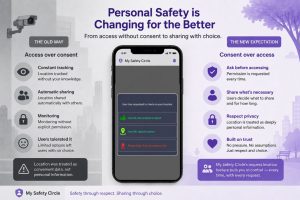
Privacy should be part of this agreement.
There is another conversation worth having before installing any safety technology:
When should location information be shared?
MSC has been designed around a privacy-conscious principle: safety information should not automatically become an excuse for unnecessary monitoring.
The broader MSC model is to keep personal information under the user’s control and make safety-related sharing available when the situation warrants it, rather than treating permanent surveillance as the default.
That distinction matters with teenagers.
If the proposition is:
“We want to know where you are every second,”
You should expect resistance.
If the proposition is:
“We don’t need to watch you. We want a plan for the rare occasion when you can’t tell us you’re OK,”
That is a very different conversation.
It turns safety technology from a parental control mechanism into something closer to a seatbelt. Mostly unnoticed. This is valuable when something unusual happens.
Don't have this conversation at 12:30am!
The worst moment to negotiate a family emergency plan is during an emergency. So talk about it when nobody is late, nobody is angry and nobody is frightened.
Ask them:
- If you’re seriously delayed and we cannot reach you, what would you want us to do?
- Who should we call first?
- When would you be comfortable with us checking your location?
- Who else should be in your Safety Circle?
- What would make this feel like backup rather than surveillance?
That conversation may be more valuable than any individual feature in an app. Because the objective isn’t to eliminate every risk from teenage life. You can’t. The objective is to replace improvisation with preparation. So when the time eventually comes — and it probably will —
The first thought isn’t: “Now what?”
It is: “We know what happens next.”
Build the protocol before you need it
My Safety Circle is designed to help individuals and families create a safety net around the moments when ordinary plans unexpectedly break down — using tools including Safe Trip, selected emergency contacts and location information when it is needed.
Explore My Safety Circle and have the safety-protocol conversation with your family before the next late night.