Mum is fine. She lives independently.
She goes shopping, sees friends, gets herself to appointments and knows exactly how she likes things done.
And if you suggested she needed to be monitored, she would probably tell you exactly what she thought of the idea.
Fair enough.
But ageing rarely announces itself with one dramatic moment.
More often, something small happens first.
She takes much longer than usual to get home.
She becomes confused on a familiar route.
She misses an appointment she never normally forgets.
She falls and cannot easily reach the phone.
Or one afternoon, something simply feels wrong — and nobody notices until much later.
That is the uncomfortable position many adult children eventually reach:
“I don’t want to take away her independence. I also don’t want to discover too late that something has happened.”
The answer should not automatically be more supervision.
It should be better preparation.
Independence and safety are not opposites
When an ageing parent is still capable and active, the instinct should be to protect that independence, not prematurely replace it.
Being able to go for a walk alone, visit the shops or manage an ordinary day without checking in constantly is part of dignity.
But independence works best when there is a plan for the exceptions.
The problem is not that Mum went out alone.
The problem is discovering six hours later that she never arrived where she normally goes.
That is where technology can be useful — not as a permanent observer, but as a quiet backup.
Look for Changes, not constant visibility
Most families do not need to know where an older parent is every minute.
What they really need to know is when something has moved outside the normal pattern.
Did Mum leave home when she usually does?
Did she arrive where expected?
Has she returned?
Is she somewhere unfamiliar and apparently unsure how to get back?
If something changes, can someone check her location quickly rather than beginning a frantic series of phone calls?
MSC’s aged-care material is built around this idea: family members can check location when there is a reason to do so and use routine-related alerts to identify situations that may deserve attention.
That is very different from watching somebody all day.
It is closer to having a safety net underneath independence.
The first unusual event matter
Imagine Mum normally walks to the same café every Tuesday morning.
One Tuesday, she does not arrive.
Maybe she simply changed her plans.
Maybe she is still at home.
Maybe she became disoriented.
Maybe she fell.
The important thing is not to assume the worst.
It is to notice that something is different early enough to check.
That small change in timing can dramatically improve the family’s ability to respond calmly.
Instead of:
“Has anyone heard from Mum today?”
the family can move toward:
“Something is unusual. Let’s check.”
That is a healthier safety model than either extreme — constant surveillance or knowing nothing until someone becomes worried.
What happens if she cannot ask for help?
Traditional safety planning often assumes the person in trouble will make the call.
But that assumption becomes weaker as people age.
What if Mum has fallen?
What if she is confused?
What if she cannot unlock the phone?
What if she does not recognise that she needs help?
Your safety plan should therefore include situations where help is triggered because something unusual has happened, not only because the person has actively requested it.
MSC’s aged-care material includes the ability to support alerts around unexpected routine changes and escalation when events such as a fall may require assistance.
The point is not to replace human judgement.
It is to make sure the family receives a reason to pay attention.
One person should not carry the whole responsibility
In many families, one adult child gradually becomes the unofficial safety coordinator.
They make the calls. They check in. They drive across town. They worry. That arrangement may work — until they are in a meeting, travelling, asleep or simply unavailable.
A better plan includes a small circle. A daughter. A son. A neighbour. A family friend. Perhaps a professional carer.
If Mum needs assistance, the person best placed to help should be able to respond.
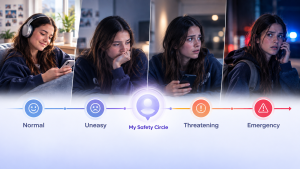
That is one of the useful ideas behind My Safety Circle: safety is coordinated around trusted people rather than depending on one person being constantly available.
Have the conversation before you need the technology
The worst time to introduce this conversation is immediately after a frightening incident.
It can sound like:
“See? You can’t manage anymore.”
Instead, have the conversation while independence is still strong.
Not:
“We need to keep track of you.”
But:
“You are independent, and we want to help you stay that way.”
Agree together:
When would it be reasonable for someone to check your location?
Which changes in your normal routine should trigger a call?
Who would you want contacted if you needed help?
Who should be able to see information during an emergency?
That keeps the older person involved in designing their own safety net.
The Goal is to not know everything
It is to know enough, early enough.
Most days, nothing should happen.
Mum goes about her life.
Nobody checks where she is.
Nobody interferes.
Nobody needs to know.
But on the day when something really is different, the family has a way to notice, check and respond.
That is not taking independence away.
Done properly, it may be one of the things that helps preserve it.
Independence when things are normal.
Family backup when they’re not.